Friday, March 15, 2013

Filioque

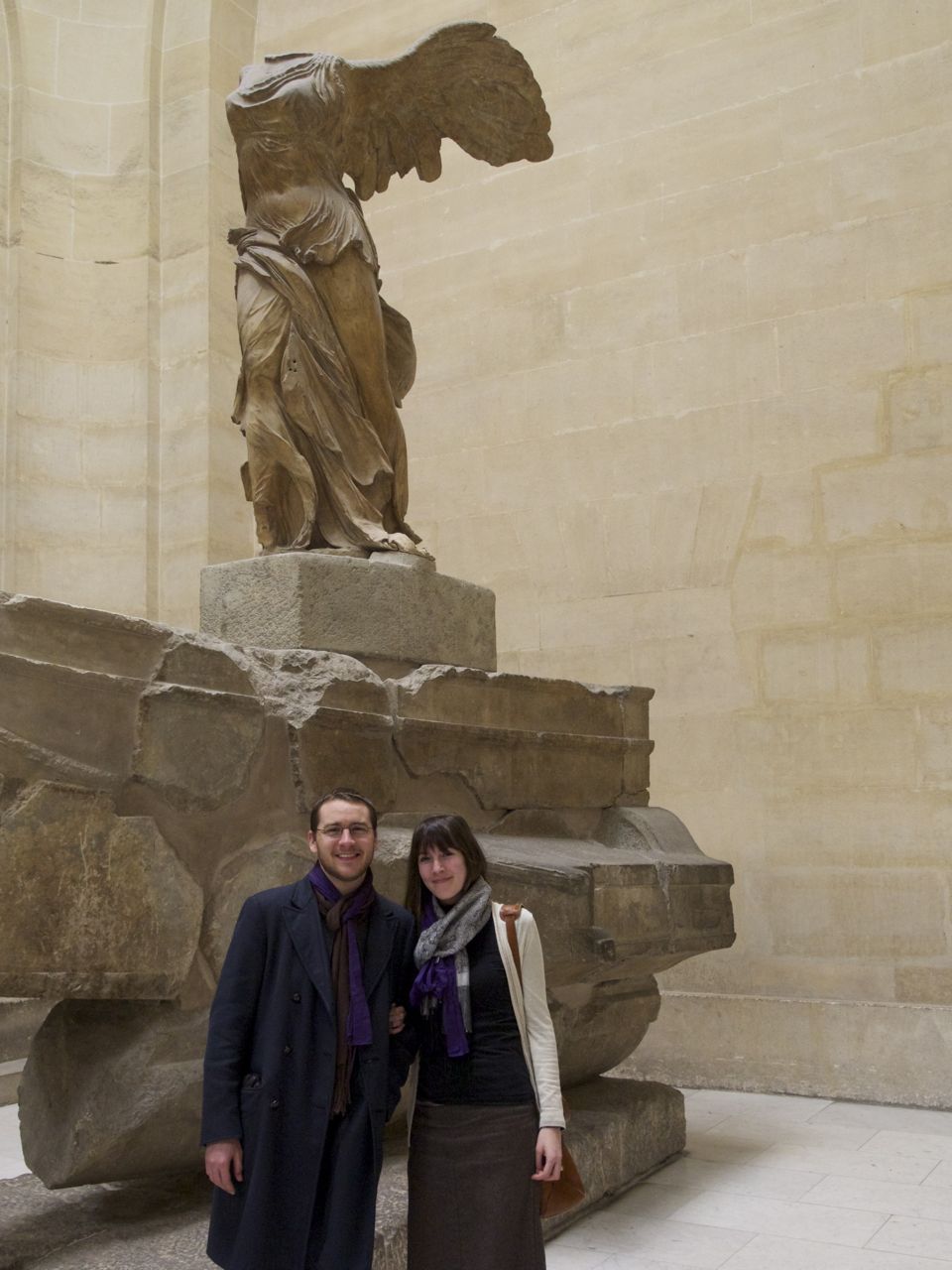
Among the many treasures to be found at the Louvre is this... 


... the first, only, and therefore absolutely greatest and most awesome visual representation that I have ever seen of the doctrine of the procession of the Holy Spirit from the Father and the Son (!).

Saturday, March 9, 2013

St. Jacques du Haut-Pas

Please excuse our long silence! We have lots of stories to tell about our recent visitors and travels, but first, here's an account of our second long and feverish tour of the left bank. The first time we made for St. Francis Xavier; this time we set out for the Hotel National des Invalides.


The Invalides is now home to a military museum, and is accordingly protected on all sides by a now-empty moat, rows of rusty old canons, and a few legions ...


... of perfectly coiffed bushes. French gardens!

We visited the small cathedral church inside the Invalides. The glass behind the church's high altar looks on to a baroque baldacchino that houses the tomb of Napoleon in the chapel behind.


Although the baldacchino was tempting, we decided to skip the tomb rather than pay to see it, and made our way promptly to a very big, randomly placed tower nearby.


Notice that the yard features more of the best of French gardens - perfectly square trees, gravel paths, and lots of straight lines. French Geometry teachers must be the happiest in the world.

Opposite the Eiffel Tower stands a peculiar sort of covered gate, made of metal shaped like the Greek letter pi, and engraved all over with the word 'peace' in different languages. While speculating on its possible significance, we got talking about pilgrimage, figuring that the gate had something to do with welcoming pilgrims. That turned our minds to the Camino de Santiago de Compostela, a medieval pilgrimage across Spain, which E walked with a friend a few years ago. She wants to do so again, taking me along with her, and we're hoping next summer will be our chance. Whether it will or not depends on our fellowships. So, in good medieval pilgrim style, I proposed we make a vow: if we both get research fellowships for next year, then we will walk across Spain to the church of Saint James of Compostela to thank God for his many gifts to us.

With that intention in mind we set off for the church of St. Jacques du Haut-Pas, on the opposite side of the left bank. The current church of St. Jacques is built on the site of a medieval church run by Hospitallers who served pilgrims leaving Paris for Compostela. Although all pilgrimages begin at your front door (and it's a dangerous business, going out of it), pilgrims usually go first to a nearby church before leaving town, and the church of St. Jacques was a popular point of departure in Paris.

We think that some of the arrows on the pavement around Paris point the way to Compostela (the many routes across Spain and elsewhere are still usually marked in some such way), but it's hard to be sure since we've seen similar arrows all over Paris, and not all of them leading the right way. Beware of false prophets.


Our trek across the left bank took us past, among other things, this unexpected and rather dilapidated pagoda, and a number of Paris's many antique shops, like that one. 


After a few miles of walking, and a couple wrong turns, we finally arrived at St. Jacques du Haut-Pas.


We made our way inside and found a fourteenth century statue of St. James where we decided to make our promises. When we left the sun had set and we were hungry. On our way home we decided to try a popular fast food chain called LeClercq, "the kings of fries." A little confusion about the metric system got us a shocked look from the man behind the counter and a giant cone filled with way more french fries than we could ever hope to finish - over a kilo! The fries were good, but the mustard didn't compare to our local spot.

Thursday, March 7, 2013

The Louvre at Night II

Please excuse our long silence! We've been hosting visitors and going on a trip or two of our own, all of which has provided us with much blog fodder, but also put us a little behind on our work. So here's a little of what we've been up to.

Going to the Louvre during its extended hours on Wednesday and Friday nights has become something of a staple for us. After a full day of work, we only want to go for an hour or two. At night, on our short trips, it seems okay to visit only one section of the museum and then go home, or to try something we know less about. The museum is less crowded--in places, almost empty, which makes me feel like some kind of intrepid museum explorer discovering secret art. Also sometimes this odd dance/music performance is going on throughout the museum, sending eerie noises through the halls. Here are some things we've seen.


Our route to the museum usually takes us past the "Elvis My Happiness La Boutique." Actually, our route to church goes there too, so we have ample opportunity to ponder why this store exists. (It seems to mostly sell Elvis paraphernalia in French, if you were wondering.)


Some spaces blend historic architectural elements into the modern museum. This is called the Henry IV staircase; I'm not sure if it was originally part of the Louvre or was later moved in.
 

Speaking of historic architecture--the Louvre used to be a palace (actually a series of palaces?) and some of the apartments of Napoleon III are preserved as part of the "objects d'art" wing. This photo is from a grand salon, each corner of which is decorated with the symbols of some art or another--sculpture, painting, etc. Here we were amused to learn that apparently Raphael's face (based on his presumed self-portrait in the School of Athens) is a symbol of painting, along with brushes and a palette! Super gaudy, but kind of awesome?


Meanwhile, the medieval decorative arts wing is somewhat structured around the idea that the middle ages were a time when France was great. It's funny for me because it's such a big change from American collections of medieval art, which have no such national history to interest them. This guy greets you when you walk in:


The sign says that he is "Charlemagne" and then in parentheses "Or Charles the Bald" and then in smaller type mentions that it was sculpted a century after Charlemagne's death. I still like the statue. It's like a mini Roman emperor, which is sort of appropriate for Charlemagne. But here's his sword:


At least, that is what the plaque says... noting afterwards that this one was created about three centuries after his life. Hm.

In another room, Abbot Suger's treasures (unlike the Charlemagne stuff, actually created by Suger) are prominently displayed. He talks about this eagle specifically in his treatise, so that's pretty exciting (to me):


The medieval section also includes tons of these tiny, finely-carved ivories.


I like the one on the left because of its portrayal of scribes at work! Probably they are supposed to be the four Evangelists, but they have a very medieval "library" on display--that box in the middle for holding books. On the right, you can see some original colors. I love the rosy cheeks, and knowing that many medieval things were not the stark, apparently restrained white or grey that they appear to us today.

Finally, on our most recent trip we had a very exciting special visitor, of whom more later. So we ventured back into the Grand Gallery, which contains a mixture of paintings I am very excited about with paintings I'm not excited about at all, is very long, and is crowded even at night:


This also meant we were finally able to have a picture of both of us at the same time--standing awkwardly in front of classical statuary, of course. Hello!

Monday, February 18, 2013

St. Francis Xavier

Our last two Saturdays in Paris have involved rather long and feverish tours through the left bank. On the first Saturday we set out for the church of St. Francis Xavier, to keep a promise to pray for a friend at the tomb of St. Madeleine Louise Sophie Barat, who founded a women's religious community dedicated to the Sacred Heart of Jesus in the aftermath of the French Revolution - while devotion to the Sacred Heart was explicitly outlawed by the French government! Glad they got over that.

Every trip to and from home has us passing one of two historic sites, since two famous persons died just around the corner from us ...

... Mozart's mother, by natural causes ... 

... and Jean Jaures, a famous French socialist, by assassination.

This particular trip took us past this beautiful clock, and that beautiful Psyche ... 


... and through this beautiful Lion's Gate ...


... onto this beautifully aged statue of Chateaubriand. 


One of the many research fellowships that E has applied for is named after him. Doesn't he look like he wants her to have it? Why, yes, I think he does.

On our way to the church we stopped at a few... churches(!). First we visited St. Thomas Aquinas, where we witnessed some of the best-executed and most convincing elements of baroque architecture that we have ever seen. The sanctuary and choir of the church are closed in by the back wall of the apse, but just behind the high altar the back wall is thrown open from floor to ceiling by stone-carved cherubim pulling back a stone-carved curtain, giving a view onto a smaller chapel behind with an altare privilegiatum (which I had never heard of before coming to Paris, but which we've seen in a number of churches by now) and a fresco of the transfiguration of Jesus on Mount Tabor. The entire effect was breathtaking - far more so than any of the best of the baroque that I've seen in Rome - and communicated a deep theological message. The curtain evokes the tabernacle, God's dwelling place among us, both in its form as the tent of meeting and as the veiled holy of holies in the temple at Jerusalem, whose curtain was rent open at the death of Christ. The fresco of the transfiguration evokes the belief in the divinity of Christ, who as God incarnate is the definitive tabernacle, God's dwelling place among us. As high priest he enters the heavenly holy of holies, once and for all, offering to God on our behalf the perfect sacrifice of himself on the cross. And all of this beneath the high altar, where that very same sacrifice is believed to be made really present in the celebration of the Eucharist. We tried to get a picture, but the impact is lost in two dimensions. You have to see it in person. 

Second we visited the Chapel of Our Lady of the Miraculous Medal, the location of a famous nineteenth-century Marian apparition. I've wanted to visit the chapel for years, ever since a friend brought me back a medal from her time in France. And I promised another friend that I would bring him back a medal, so we had to go. I didn't know before visiting, but apparently a number of great saints have worn the miraculous medal. Blessed John Henry Newman was wearing one when he converted, St. Therese of Lisieux wore one in the convent, and St. Bernadette Soubirous was wearing one at the time of the Marian apparitions at Lourdes. 

On our way from the chapel to the church we wandered down the Rue de Varenne, which brought us to the Musee Rodin, the former home and studio of the famous sculptor whose work E and I both like a lot. For some reason (which we didn't dare to question) we were given free access to the gardens (thank you, France!), which feature a number of the artist's works in bronze, and to a temporary exhibit of some of his works in marble. As it turns out, the Hotel Biron, the eighteenth-century mansion that now houses the museum, has quite an interesting and varied history. I was floored to learn that among its many famous owners and tenants (which include the painter Matisse and the poet Rilke) was St. Madeleine Louise Sophie Barat! She and her sisters after her ran the house as a convent and boarding school for girls for the better part of the nineteenth century. That explains the otherwise totally out-of-place neo-gothic chapel on the mansion's grounds:


The sun was beginning to set as we left the gardens ... 


... which gave us a beautiful view of the dome of the nearby Hotel National des Invalides, which houses the tomb of Napoleon.


That view pretty well made up our minds about where the next Saturday's tour would take us. This one ended, as we planned, at St. Frances Xavier.


Fortunately for us, the subway stops right in front of the church, so we decided to take it home rather than walking the four miles back. You can be a pilgrim on the subway too.

Thursday, February 14, 2013

St Denis

St Denis was once a village just north of Paris, known pretty much only for being home to the monastery of St-Denis, where the kings of France were buried. Now it is a somewhat disreputable suburb, known mostly for the same thing. Last weekend we went to visit.


As you can see, it's a little dismal outside but full of light inside.

What's exciting for me about St-Denis--and the main reason we visited--is that it's famous to medieval historians, so I've been reading about it for years. There are a few reasons for its fame. First, it is possibly the first church built in the Gothic style. Some elements of Gothic style appeared elsewhere first, but what was new at St-Denis was putting them all together, and the unique effect they create in concert. Pointed Gothic arches distribute weight differently than the round Romanesque arches of the early middle ages (you can see some of these on the church's facade--elements of the older style remain), so less wall was needed to hold up the weight of the ceiling. Flying buttresses on the outside of the church support the walls too, counteracting the outward push of that heavy roof. But why all this extra support for the walls? So they could be pierced with giant windows that would let in the light, filtered through stained-glass windows, of course! The big windows combine with other elements of the architecture, like the ribbed pillars and the vaulting (vaulting is basically the ceiling's three-dimensional version of the pointed arch, and has a similar effect on weight distribution), to give it an overall feeling of height, verticality, and upward movement.

Here's big- and small-scale Gothic ornamentation combined in the Ste-Chapelle, and similar details on the Tour St Jacques.

But wait! There's more! Statues got taller and thinner too, mirroring the height of the churches. Gothic ornamentation--like the motif of the pointed arch-top or the three- or four-lobed shape like a clover, which you can see above--started not only to be applied on a big scale as architectural elements, in window frames and church facades, but also to be repeated in decorative details on a small scale, on tombs, statues, and precious objects like reliquaries. Some art historians call the Gothic a "total" style for this reason. It's also called an "international" style, because after it became popular in France it spread rapidly all over medieval Europe.

Abbot Suger of St-Denis is the little monk supplicating at the feet of the Virgin Mary in the Annunciation on the right.
Of course the abbey church of St-Denis didn't directly cause all of that. But it may have provided the germ. Like many churches, St-Denis was rebuilt in the twelfth and thirteenth centuries. What's unusual is that we know a lot about it, because the abbot who oversaw the twelfth-century renovations conveniently wrote a treatise about what was accomplished during his administration. Abbot Suger was given to the monastery as an oblate when he was only 10 years old, and tells us that he thinks of it as his mother--a mother to whom he wanted to give the gift of expensive church renovations(!). They are fitting, he says, because meditating on the sparkling light of the windows and the jewels in his renovated church helps to lift the mind to the light of God. We've been in a number of Gothic churches before now, and many bigger, but St-Denis still impresses me with all the light it lets in.

Look at how much of that wall isn't wall but rather window! St-Denis' rebuilding was also influential in making subsequent medieval architects realize that rose windows are awesome.

On one of our trips to the Louvre, I was excited to find that they still have some of the ancient jewels and relics which Suger mentions collecting and having set in gold! If you're in DC, you can see another one of these, a chalice re-set by Suger, at the National Gallery of Art.

 
You can see his name (SUgER) across the bottom.

As a patron saint of France, Saint Denis had a lot of significance for its monarchy. The story about this third-century bishop of Paris and martyr goes that after he was beheaded, he picked up his head and marched six miles from Montmartre (the "mount of martyrs") to St Denis, where he finally died, preaching all the while. This makes him easy to spot in art, incidentally. The church was, as I mentioned, the burial place of the kings of France since something like seventh century. So the monks of St-Denis were the main people charged with praying for the souls of the dead kings. They eventually became the official keepers of French royal history, too, which they wrote throughout the thirteenth and fourteenth centuries. The oriflamme, the battle standard of the kings of France, was kept at St-Denis, and retroactively associated with the standard of Charlemage as mentioned in the Chanson de Roland. My work is about how another ruling dynasty--the ducal family of Normandy aka (after 1066) the kings of England--was commemorated in histories and in monks' memories, so it's super cool for me to visit this place which was a focal point for history-writing and -remembering in France.

A pre-revolutionary but post-medieval Oriflamme in St-Denis. Photo from my previous trip in 2010.
All of this is a bit odd to remember while standing in a mostly-empty church in the French Republic. These days St-Denis shows the commemoration of the kings mostly in housing their effigies:


I'm not sure I would recommend the longish trek by metro out to St-Denis--at the end, you have to pay to enter the back of the church, presumably because its upkeep has been handed over by the impoverished church (the monastery was suppressed and destroyed in the revolution, like all the others) to the Centre des Monuments Nationaux. But for me, it was fantastic to return and to share it with T.

Sunday, February 10, 2013

Tut Tut

This weekend I picked up a used copy of A. A. Milne's classic Winnie ille Pooh - that's Winnie the Pooh in Latin - thinking that it might lift my spirits during another rainy weekend in Paris. As I flipped to the page most relevant to my current woes, where Pooh utters that most profound adage, "tut tut, pluvia impendat" - that's "tut tut, it looks like rain" - a folded sheet of old parchment fell out of the book and onto the floor. I picked it up and began to read, flabbergasted and amazed at what I had found. The parchment seemed to be a long lost question from St. Thomas Aquinas's Commentary on the Sentences of Peter Lombard, the "doctoral dissertation" which he composed while living in Paris between 1252 and 1256. I have little doubt about the authenticity of the text, since it is written in Aquinas's famous littera illegibilia - that's "illegible handwriting" - and addresses a topic which he must have thought about often while living and working in Paris. What a find!

I've gone through the trouble of translating the text from Latin into English for you, but first I should say something about its style. The text is written in the high-medieval disputatio style, which follows this form: first a question is raised for dispute; then arguments are presented for the opposing side of the dispute; then a contrary opinion is cited either from an accepted authority or from reason; then the author gives his own answer to the question; and finally he responds to each of the arguments presented for the opposing side. That's it. Enjoy!


Utrum Parisius semper pluat: Whether it is always raining in Paris.

1. And it seems that it is not. For Paris is the “city of light.” Yet as light is to sunshine, so is darkness to rain. Therefore, it is not always raining in Paris.

2. Moreover, at least some sinful people live in Paris, for “all have sinned and fall short of the glory of God” (Rom. 3:23). Yet in his Commentary on the Sermon on the Mount, Augustine makes it clear that the sinful are represented by the vineyard of which the Lord says, “I will also command the clouds that they rain no rain upon it” (Is. 5:6). Therefore, it is not always raining in Paris.

3. Moreover, after the flood God promised Noah that “the water shall never again become a flood to destroy all flesh” (Gen. 8:15). Yet it only took forty days and forty nights of rain to cover the whole face of the earth with water. And so if it were always raining in Paris, there would be a second flood and God’s promise would be broken. Therefore, it is not always raining in Paris.

But on the contrary, it is said in the book of Job, “For to the snow he says, ‘Fall on the earth’, and to the shower and the rain, ‘be strong’,” (Job 37:6) and again in the book of Matthew, “he sends rain on the just and on the unjust” (Mat. 5:45).

I respond that it must be known that rain is said in many ways. In one sense rain is meant to refer to precipitation, that is, any product of the condensation of atmospheric water vapour that falls under the force of gravity. It is of rain in this sense that the poet speaks who says, “Rain, rain, go away, come again another day.” In another sense rain is meant to refer metaphorically to the effects of a superior cause, as when it is said in the book of Isaiah, “let the skies rain down righteousness” (Is. 45:8). And there are as many different types of rain in this sense as there are different types of effects of a superior cause. Now, in the first sense of rain, that is, precipitation, it must be said that it is always raining in Paris, for there is always some kind of precipitation in Paris, whether dew, mist, rain, snow, sleet, hail, or (as is usual from January to March) all of them at once. And this is clear even from the etymology of the name Parisius (Paris), which derives from the words pluvia (rain) and semper (always). Moreover, even in the second sense of rain, that is, the effects of a superior cause, it must be said that it is always raining in Paris. For as was proved above in a previous question, God is the first cause of all that exists, not only insofar as he causes all things to begin to exist, but even insofar as he causes all things to continue to exist at every moment at which they exist. Therefore, since there is always something (other than God) existing in Paris, it is always raining in Paris. Moreover, as will be shown in a later question below, God always bestows grace upon the elect, according to the promise of Christ, “Lo, I am with you always, to the close of the age” (Mat. 28:20), and especially to the lowly, as it says in many places, “God opposes the proud, but gives grace to the humble” (James 4:6; 1 Peter 5:5). Therefore, insofar as there are always some elect in Paris upon whom God bestows grace, it is always raining in Paris.

1. To the first I say that the analogy fails, since light and darkness are mutually exclusive, as black and white, but sunshine and rain are not, since rain can fall while the sun shines.

2. To the second I say that Augustine makes it clear in that passage that he means rain in the second sense and not in the first. And nothing prevents there always being one type of rain in this sense but not another type.

3. To the third I say that God’s promise to Noah pertains to rain in the first sense, but not in the second. Yet rain in this sense admits of diverse quantities, as is clear from the difference between a light shower and a torrential downpour. Therefore, since the flood was caused by forty days and forty nights of torrential downpour, it is clear that God could not cause it always to rain that much in Paris without breaking his promise. Nevertheless, nothing prevents God from causing it always to rain in Paris in some quantity less than a torrential downpour, or in some mixture of more and less, day in and day out, as in fact it does. Moreover, it is particularly fitting that God should cause it always to rain in Paris, for the sign of his covenant with Noah, the rainbow, is only naturally manifest in the presence of precipitation. Therefore, since God remains always faithful to his promises, and that even in Paris, it is fitting that he should cause it to rain always in Paris at least enough that there always be a rainbow in the sky, as in fact there is.

If this little gem has piqued your interest in long lost texts of Aquinas, here's another one on a pressing question for our times: whether sermons are always boring!

Tuesday, February 5, 2013

Rheingold

We made our first venture to the opera in Paris last week. Rheingold was on, the first part of Wagner's Ring cycle. I love the Ring, for its music but also partly because it's super weird, combining Norse gods and ordinary people, magic and destiny and normal human choices. Of course, the weirdness makes it difficult to stage. And Wagner's ideas about German nationalism, and the later use of his music for Nazi propaganda, make it even harder, especially in Europe--so I was excited to see my first live European performance.

The Opera de Paris sells a number of standing-room places on the day of each performance for only €5, but they are in high demand, and sold to the first in line when the doors of the house open. So about four hours before the performance we set off for the opera house. Our walk took us through the Marais, one of the oldest neighborhoods of Paris, which shows its age with winding cobblestone streets and medieval buildings. Unfortunately the narrow streets meant I couldn't figure out how to photograph any of the former palaces and fortresses we passed! We came out of this maze on to the Place de la Bastille:


This is a monument to the July Revolution of 1830 (incidentally, the revolution that Delacroix's Liberty Leading the People is about; it's not about the 'main' French Revolution of 1789). The Bastille itself was torn down in the 1789 revolution and now has some cafes on top of it. Here's the opera house:


This guide to getting standing-room tickets is still quite accurate, in case you ever find yourself wanting to stand through an opera in Paris. An apparently devoted opera-going youth (he looked super young!) was organizing those who wanted to buy standing room tickets, and gave us a number. Many of our fellow-standers were both young and enthusiastic about the opera (including one student, wearing a fashionable cloak, who said he had stood through the entire Ring when they last put it on.) which is not necessarily the case at the Met. Maybe having tickets a third the price also helps to encourage this audience!

About an hour and a half before the show, we lined up by our numbers, not without a certain amount of jostling. Amid the jostling I began to realize that one of our companions, a self-proclaimed philosopher, was telling any strangers who would listen to him that Nietzsche was right: God was dead (!). He illustrated his points with a number of historical anecdotes that were mostly completely false (I can only speak for the medieval ones) but was gloriously undeterred by everyone else pointing this out. It was a bizarre experience--made slightly less so by the other French opera-goers assuring us, once they realized that we were from out of town, that "not all French people were crazy."

The best standing-room places went first, so by the time we got to buy our tickets we ended up with spaces at the very top of the house. But, fortunately for us, there were a lot of unused places. And, again unlike the Met, the ushers seemed very happy to allow the standers to sit down in unused seats, and even helped many of us to find seats as the lights dimmed. So civilized! And, to our pleased surprise, we found that English translations were provided as well as French.

The gorgeous, slow prelude seemed a bit muddy to me, but after that the orchestra warmed up (?) and, since I am totally unqualified to talk about the music, I shall only say I mostly really liked it musically, and that among the awesome singers Sophie Koch as Frika was extra awesome.

It was very much not the sort of production that people like at the Met. Here are the gods, on top of the world (their new castle Valhalla is being built in the background but you can't see it):

Opera nationale de Paris - not my photo and not the cast we saw.
For those of you who don't know the plot, here's a quick(ish) summary: The dwarf Alberich steals a lump of magical gold from the river Rhine which can be forged into a ring that would give its owner world dominion--but to forge the ring, he must curse love, and Alberich does. Wotan, king of the gods, has just had two giants build him a castle. He promised them the goddess Freya as their payment, but if the gods give her up they will die, because she alone can grow the golden apples that keep them young and strong. As god of just kingship, Wotan's power rests on his support of oaths and contracts, so breaking one of his own would basically doom him too. Loge, trickster god of fire, tells Wotan that Alberich has grown wealthy and powerful in his underground kingdom with his newly-forged ring. Wotan and Loge steal the ring, but Alberich curses it: everyone will want it, but it will always cause its owner's death. Wotan wants to keep it but is ominously warned by the earth-goddess Erda not to. The giants accept the ring and treasure in place of Freya, but immediately fight over it and one giant brother kills the other. As the other gods triumphantly enter Valhalla, Loge notes that with the cursed ring still in the world, the downfall of the gods may already be in motion.

For an alternate and much funnier synopsis, just watch this video.

A thing I liked about the production: the characters were really well-directed and coherently developed. For example, Frika, queen of the gods and Wotan's wife (who often gets stuck being a stereotypical shrew), in this production is nearly as power-hungry as Wotan--but she seems to know what's going on with Wotan's schemes, and to have plans of her own. Loge is portrayed as completely cynical: he knows that the gods are sort of rotten people, and doesn't take their grandiose posturing seriously because he sees their limits. And unlike in some presentations, these coherent characterizations meshed into a bigger picture, and so I imagine they were the director's work.

A thing I did not like: the gods really are completely awful power-hungry people in this production. They are often portrayed as having some good qualities--Wotan is wise; Frika loves her family; etc.--which slowly become twisted as Wotan starts violating his principles in order to hang on to power. Now it doesn't seem like a distorted interpretation of the libretto and music to highlight just how wrongly the supposedly good gods act: it's pretty bad. Some probably think that it makes a statement against tyranny to show the gods, who represent an old world order, in the worst possible light. My problem, though, is that it's boring. In this production, Wotan starts out interested only in power for its own sake, and at the end of the night, he's still only interested in power. Isn't an ambiguous and evolving character more interesting? Isn't a drama that centers on characters' changes and choices more compelling?

Opera national de Paris - not my photo.
Plus, the concept seemed to be to compare the gods to early-twentieth-century Germany--not a very original idea--which was accomplished partly through having giant banners, and later block letters, that say "Germania"--not too subtle. So I don't feel like this dramatic potential was lost in order to say anything very interesting.

That said, I would absolutely love to see direction of the actors like this all the time, and will obviously be going back for the next installment!